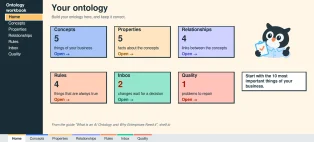
Learn how insurance carriers build AI ontologies across policy forms, state endorsements, and claims SOPs in weeks instead of months—moving from a full modeling team to one domain owner backed by AI.
BeforeAfter
✕
Months to model one line of business
→
✓
Working line-of-business ontology in a week
✕
Requires ontologists plus claims & underwriting SMEs
→
✓
Target: 1 domain owner, backed by AI
✕
Senior underwriters & adjusters are the bottleneck
→
✓
AI scales expert coverage decisions across lines
✕
State endorsements outpace manual updates
→
✓
Target: 97%+ claims & policy use-case coverage
✕
Exclusions and riders drift out of sync across PDFs
→
✓
AI assistant flags policy drift and proposes updates
✕
Coverage errors surface only in bad claim decisions
A machine-readable map of policies, coverages, and exclusions.
An insurance ontology defines your core domain concepts—policyholder, coverage, policy, and claim—along with their limits, deductibles, waiting periods, relationships, and exclusion rules. An AI ontology grounds claims, underwriting, and member-service agents in those explicit definitions instead of probabilistic guesses.
It encodes coverage hierarchy, not just policy tags.
A product catalog lists codes; an ontology captures relationships and coverage semantics. A knowledge graph then populates that model with active policies, state filings, riders, and open claims.
Take a policy schedule tagged “Premier.” On its own, that label tells an AI copilot nothing. An ontology defines what it means: “Premier” sits above Basic and Plus, raises sub-limits, and unlocks commercial endorsements that personal lines exclude.
It gives AI one shared reference across underwriting, claims, and service.
Policy booklets, state riders, and admin systems map to the same canonical concepts so every AI workflow interprets coverage rules consistently—once wired into retrieval, reasoning, and agent assist.
The key is the link. Carriers store decades of policy forms, bulletins, and adjuster guidelines across SharePoint, policy admin systems, and PDF repositories. Linking a single claim-review concept to its governing forms and call topics powers FNOL triage, adjuster analytics, and loss-ratio KPIs from one governed model.
It’s built from policy booklets and endorsements, not just policy tables.
Core policy admin tables tell you a policy number, effective date, and limit—they already have structured columns.
The rules that actually decide a claim live outside tables: 80-page policy forms, state-specific endorsements, underwriting manuals, rate tables, adjuster training videos, and recorded FNOL calls—unstructured content.
Extracting an AI ontology directly from those documents—with every carve-out and cross-reference intact—is vastly harder than querying a warehouse schema.
2
Why are AI ontologies essential for insurance AI?
They answer coverage questions that depend on riders and state rules.
Questions like “Does this policyholder qualify for water-backup coverage under their state endorsement and deductible?” cannot be answered from one isolated paragraph. They depend on connected policy terms, sub-limits, and exceptions—precisely what an ontology encodes.
They eliminate terminology collisions between Underwriting and Claims.
Terms like “insured,” “active policy,” or “covered loss” carry different boundaries in Underwriting, Claims, and Billing—from named insureds vs. permissive drivers to grace-period policies. An ontology makes each distinction explicit so AI never conflates two rules.
They make insurance AI auditable for compliance and regulators.
Explicit models let you run logical consistency checks across endorsements, validate live rule updates with SHACLShapes Constraint Language—the W3C standard for validating graph data against explicit structural and business rules. constraints, and maintain full provenance tying every coverage answer back to the exact form, edition date, and state filing.
A homeowner asks your claims assistant: “Is water backup covered under my policy?”
Keyword search retrieves three documents: Home Policy.pdf,Water Rider.pdf, and Comm. Flood.pdf.
Home Policy and Water Rider use different titles, yet together they govern a residential water-backup claim: covered up to the endorsement sub-limit after a $1,000 deductible.
Comm. Flood shares the word “water,” but applies to commercial flood policies—where sewer and drain backup is excluded.
Keyword overlap cannot tell a policy rider from an exclusion. Without an ontology, search can surface the commercial exclusion and tell the homeowner “Excluded.” With an ontology, the assistant maps each file to the right line and endorsement—and answers “Covered” with the exact sub-limit.
3
Why building insurance ontologies the old way does not scale
Senior underwriters and claims leads become the bottleneck.
Turning dense policy forms, state exceptions, and underwriting appetite into formal hierarchies requires endless interviews between senior adjusters, product attorneys, and ontology engineersSpecialists who design and maintain formal ontologies, translating business concepts, relationships, and rules into machine-readable schemas.—repeating for every new state filing or line of business.
Reconciling multi-line definitions by hand is slow and fragile.
Auto, home, life, and commercial teams each maintain slightly different definitions of loss, deductible, and eligibility. Resolving those conflicts manually and testing whether the model handles edge-case claims takes months—and still misses rare endorsements.
State filings and form revisions never stop.
Every time a state department of insurance approves a new endorsement, coverage cap, or rate filing, the ontology, form mappings, and downstream copilots must stay in sync. One-off ontology builds go stale inside a single renewal cycle.
LLMs miss policy hierarchy and exclusion logic.
An LLM can pull terms like “peril,” “endorsement,” and “sub-limit” out of a booklet, but regularly gets override precedence wrong—failing to model when a state rider supersedes a base exclusion. A plausible-looking schema still yields wrong claim guidance.
A schema alone doesn’t turn policy PDFs into a clean graph.
Even after you design an insurance ontology, parsing multi-column forms, resolving form edition numbers, mapping endorsements to base policies, and validating live updates remain heavy engineering pipelines.
Unmonitored ontology errors multiply across thousands of claims.
Valid syntax does not prove your model matches filed policy language. Because an ontology governs downstream AI as metadata, one wrong exclusion rule multiplies: a bad document spoils one lookup, while one mis-modeled coverage rule corrupts every adjuster and member answer that relies on it—with no audit trail showing the blast radius.
4
The new way to build an insurance AI ontology
You can prototype an insurance ontology with off-the-shelf AI. Standing up one line of business is straightforward—scaling across 50 states, multiple lines, and strict compliance audits is where the engineering starts.
1Start from insurance standards and templates, not a blank page
Never model insurance from scratch. Public standards like schema.org and W3C vocabularies are too generic, while insurance references such as ACORD and FIBO offer strong starting concepts for parties, policies, coverages, and claims.
Have an AI agent pull relevant building blocks from ACORD, FIBO, and domain templates covering personal lines, commercial lines, endorsements, and claims.
The catch: reference standards never capture your carrier’s proprietary riders, state-specific filings, or underwriting exceptions. You still have to adapt the starting model to your exact policy portfolio.
2Turn policy booklets and riders into a lossless, AI-readable format
For a small test, upload a single policy booklet to ChatGPT, Claude, or Gemini and ask for structured markdown.
Insurance PDFs expose the limits immediately: redlined edition updates, crossed-out clauses, nested exclusion tables, schedule sub-limits, and cross-references to separate state riders all change coverage outcomes. If a parser drops a strikethrough or splits a table from its footnotes, your AI invents coverage.
Doing this cleanly for 10 forms is manageable; doing it losslessly across 100,000 policy editions, underwriting bulletins, and claims manuals requires a dedicated document pipeline.
3Mine coverages, perils, and rules—then reconcile across lines
Ontology mining extracts candidate concepts—coverages, perils, deductibles, waiting periods, exclusions—and the relationships between them directly from your structured policy files.
Extraction per PDF is easy; reconciliation across lines is the hard part. One filing calls it “payout,” another calls it “indemnity,” while “claim” means different workflows in personal auto versus commercial property.
AI can propose merges and flag overlapping terms, but an underwriting or claims owner has to approve every definition.
4Put a governed compliance inbox in front of every change
In a regulated carrier, an AI assistant must never edit live coverage logic directly. Route every plain-language change request into a review inbox where product, claims, or legal owners approve or reject updates with full audit history.
For a single-line pilot, a structured spreadsheet is enough to test the workflow—we started there too.
Spreadsheets collapse as soon as you expand across lines and states. Production insurance models track millions of policy instances, riders, coverages, and documents—pushing teams toward graph databases like Neo4j, Amazon Neptune, JanusGraph, or QLever.
Running a graph database adds dedicated ops overhead, custom query languages, and synchronization with policy admin systems. Because an ontology is data about your policy data, it demands edition versioning, branching, sign-off workflows, and audit logs.
5Run continuous QA before coverage errors reach adjusters or members
Validate your insurance ontology after every filing update. Automated checks catch missing definitions, duplicate coverage names, and endorsements pointing to retired base forms.
Next, have an LLM check whether each definition is unambiguous for a new claims adjuster. In a starter sheet, Google Sheets’ AI function (on eligible Google Workspace or Google AI plans) can run that pass across every row: =AI("Is this definition clear to a new claims adjuster? Answer Yes or No, and give the reason.", E11)
Clarity checks catch vague language, not regulatory or policy errors. Catching when a new state bulletin contradicts a live claims SOP requires continuous cross-document validation owned by domain experts.
This DIY workflow proves value on a single policy form. Across dozens of states, legacy editions, and regulated claims workflows, every layer becomes its own production system.
5
Insurance AI ontology architecture
How the five layers connect from raw policy booklets and state filings to production claims and underwriting AI.
Input
Policy forms & filings
Policy PDFs & riders
Admin systems
Insurance AI Ontology Infrastructure
1
Insurance templates
ACORD & FIBO
Line-of-business models
Reusable rules
2
Lossless policy format
Exclusions & tables
Redlines & footnotes
Edition lineage
3
Coverage mining & sync
Rule extraction
Synonym merging
Line disambiguation
Insurance AI ontology
Coverages
Endorsements
Exclusions
State rules
4
Governed compliance inboxpropose, review, approve
Change inbox
AI Ontologist
SME sign-off
5
Continuous policy QAcatch contradictions & drift
SHACL rules
Contradiction checks
Audit provenance
Output
Insurance AI apps
Claims assist
Underwriting
Member self-service
Detail
6
Hiring an ontology team vs. AI-assisted insurance infrastructure
Even a seasoned insurance ontologist spends their first year building parsers, graph sync, and compliance workflows unless the infrastructure already exists.
Building in-houseWith AI-assisted insurance infrastructure
✕
Hire ontologists, ML engineers, and pull senior adjusters off claims
→
✓
1 insurance domain owner backed by an AI Ontologist
✕
4–9 months to hire, model one line, and map state riders
→
✓
Working line-of-business ontology in about a week
✕
Build custom OCR for policy schedules, redlines, and footnotes
→
✓
Lossless parsing for forms, rate tables, slides, and FNOL calls
✕
Operate and sync a graph DB alongside policy admin systems
→
✓
Managed semantic + OLTP store with edition branching and audit logs
✕
Track endorsement approvals across spreadsheets and email threads
→
✓
Governed review inbox where underwriting & claims approve updates
✕
Discover policy contradictions after an adjuster sends a wrong answer
→
✓
Always-on contradiction, exclusion-gap, and coverage monitoring
7
Build in months or get it out of the box right now
Two years ago, we started building AI ontologies for complex, regulated enterprises—including large multi-line insurers. Off-the-shelf tools broke immediately on real policy corpora. Here are the five engineering problems that forced us to build dedicated infrastructure.
Graph databases aren’t built to be a regulated source of truth.
We started on Amazon Neptune; latency spiked as soon as concurrent adjuster and agent traffic scaled up.
We benchmarked Neo4j, GraphDB, QLever, Oxigraph, JanusGraph, and others—every option fell short for production insurance workloads.
Property graphs lack OWL semantics for coverage inheritance and exclusions, while RDF stores lag behind OLTP databases on reliability and write throughput.
Fronting a graph DB with an OLTP database introduces a dual-write sync hazard you cannot tolerate on policy rules—so we built a unified storage layer engineered to be the source of truth.
No collaborative governance tool exists for multi-line policy models.
Underwriting, claims, legal, and product teams all edit overlapping definitions—and disagree on how perils, coverages, and exceptions nest.
Without real-time collaborative workflows and ownership, every state-filing update turns into manual spreadsheet reconciliation.
Reprocessing policy forms and bulletins at scale gets expensive fast.
Carriers manage hundreds of thousands of forms, endorsements, and claims SOPs that shift with state filings and renewal cycles.
High-precision extraction of exclusions and sub-limits requires frontier models—roughly $5,000 per 100,000 documents on a full pass, adding ~$1,500/month at 1% daily churn unless extraction is diff-aware and incremental.
Branching and testing a policy revision before it goes live.
A single endorsement can alter coverage rules across an entire state portfolio. How do you test a new branch against historical claims questions before promoting it to production?
Spreadsheets break under regulatory audit requirements:
Every regional team forks its own copy.
Nothing catches broken links when a base policy edition retires.
Version history degrades into dated copies with zero lineage.
Standard OCR and PDF parsers silently erase coverage meaning.
We tested commercial parsers, traditional OCR, and ML-based OCR on dense policy booklets and rate schedules.
In insurance PDFs, strikethroughs in redlined endorsements, footnote cross-references, colored callouts, and draft vs. filed edition status directly determine whether a claim is paid or denied.
We built a lossless, AI-readable format that preserves text, table structure, redlines, and edition metadata together.
We learned what breaks on real policy corpora the hard way. So we built Shelf Cortex, paired with Aristotle AI.
Tell Aristotle in plain language which line of business or filing changed—it mines the ontology from live forms and manuals, flags contradictions against existing SOPs, explains the impact, and stages fixes for sign-off across millions of files and thousands of adjusters.
ComponentWhat it does
110,000+ Ontology TemplatesPrebuilt models for P&C, life, health, underwriting, and claims—so you start from working insurance structure instead of a blank slate.
2Cortex Knowledge Data ProcessorLosslessly parses multi-column policy PDFs, state riders, rate tables, redlines, training videos, and FNOL call recordings.
3Cortex AI Knowledge StudioOne governed workspace where underwriting, claims, and compliance review, branch, and approve every ontology change with full audit history.
4Aristotle AI AssistantPlain-language AI Ontologist on top of your model: mines coverage rules, explains policy conflicts, and stages proposed updates for human approval.
5Cortex SentinelContinuously checks live claims SOPs and policy updates against your ontology, catching contradictions before an adjuster or policyholder gets a wrong answer.
8
Impact of using Shelf as your insurance AI ontology infrastructure
1
Launch lines in weeks
Move from policy booklets to a production insurance ontology in weeks, not quarters.
2
Protect SME time
One domain owner backed by AI—keeping senior underwriters and adjusters on core work.
3
Raise coverage accuracy
Ground claims and member copilots in explicit rules to target 97–99% accuracy on covered lines.
4
Scale across states faster
Roll out new endorsements, products, and state filings without rebuilding from scratch.
5
One auditable foundation
Power FNOL, claims assist, agent guidance, and member portals from one governed model.
Hiring an insurance ontologist or scoping a claims AI pilot? Send us 20 coverage or claims questions your AI gets wrong today—we’ll show you which ones an ontology fixes.